Blog | Tree Planting
Picking and Planting Three Common Types of Nursery Trees

Planting a new tree is one of the most rewarding ways to improve a landscape. You get the joy of knowing that you made a long-term improvement to the land and provided habitat for local wildlife, but long-term success depends heavily on planting it correctly. Trees are sold in several different forms, and each type requires slightly different handling and planting techniques. Each type of nursery stock has pros and cons, and its helpful to know which is best for you and your yard.
The three most common types of nursery stock are balled and burlapped (B&B) trees, container-grown trees, and bare-root trees. Understanding the differences between them will help ensure healthy establishment and decades of growth.
1) Balled and Burlapped (B&B) Trees
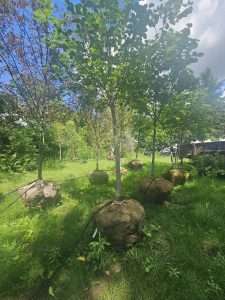
Balled and burlapped trees are grown in the ground at a nursery, then dug with a soil ball around their roots. The root ball is packed in clay, wrapped in burlap, and often secured with twine and a wire basket to hold it together during transport. This is the most commonly sold type of nursery stock, and because the trees are grown in the ground, nurseries are able to sell larger specimens. This makes them a popular choice for homeowners who want more immediate impact. Commonly, wider species selections are available. B&B trees are larger, heavier, and therefore more difficult to transport and plant on your own. The process of digging B&B trees involves cutting off a majority of their roots systems, so these trees can show more signs of transplant shock and take longer to reach establishment.
How to Plant B&B Trees
Step one of planting B&B trees is to remove any twine and at least the top portion of the wire cage, but ideally the whole cage. You will need to pull back some of the clay and soil to expose the root flare of the tree. Inspect the root flare and buttress roots for any damage or for girdling roots. When planting a B&B tree, the planting hole should be two to three times wider than the root ball, but no deeper than the height of the root ball itself. The tree should be set so the root flare is visible at or slightly above the soil surface.
Once the tree is positioned, remove as much of the remaining twine, burlap, and wire cage as possible. Ideally, this would all re removed, but if your root ball is not solid, you can leave the bottom portion of cage/burlap to stabilize the root ball.
The hole should be backfilled with the original soil, gently firmed to remove air pockets, and thoroughly watered. Mulch should be applied in a wide ring, keeping it away from direct contact with the trunk.
2) Container-Grown Trees
Container-grown trees are grown entirely in pots, in a controlled planting medium, kept in nurseries several years, until they are ready to sell. Container-grown trees are lightweight, easier to transport, and are more available throughout the growing season. Unlike balled and burlapped trees, container trees keep 100% of their root system while being transplanted, so they tend to reach establishment more quickly. Container grown trees are growing in popularity because of their ease of transport, but not every species transplants well when container grown. There are also a few extra steps you have to take when planting container trees to avoid future issues.
How to Plant Container Trees
 Begin by carefully removing the tree from its container and inspecting the roots. If roots are circling the pot, and they almost always are, they must be corrected before planting. There are a few ways you can achieve this. If there are only a few circling roots, you can gently tease out the roots and rearrange to go outward from the trunk. If you find a very dense root ball, you may need to cut some roots to disrupt the circling pattern. You can do this by cutting vertical lines into the root ball, or by shaving off the outmost layer of roots. You also need to make sure that the root flare is exposed.
It’s common for container trees to also be planted deep in their containers, and the fine roots will grow upward into the planting medium and begin to circle around the base of the trunk. If circling roots are not corrected at the time of planting, the roots will forever grow in this pattern, and will become girdling roots in the future. As both the trunk and the roots expand in size, they will push against each other and the roots will cut off circulation in the trunk. Trees with girdling roots eventually constrict themselves to death if they are not corrected in time. Keep in mind that girdling roots CAN sometimes be corrected within the first few years of a tree being planted, but once a tree is established and growing for several years, they may not able to be fixed.
The planting hole should be wide and shallow, with the root flare at or slightly above grade. After positioning the tree, backfill with native soil, water thoroughly, and apply mulch. Because the roots balls of container trees are more lightweight, you may need to stake these trees upon planting if they are exposed to strong winds.
3) Bare-Root Trees
Bare-root trees are sold without soil around their roots and are usually available in early spring or late fall while trees are dormant. They are grown in planting medium, like gravel, and then the planting medium is removed for transport while the tree is dormant. Because they are lightweight and easy to handle, bare-root trees are often more affordable and can establish very quickly when planted correctly. Thee are a few limitations with bare-root trees. Many species don’t do well when grown and transplanted bare root. Bare-root trees are always going to be smaller and younger. Because they are smaller, and they keep all of their roots during transplant, they tend to experience less transplant shock and establish quickly. This makes bare-root a good choice for smaller budgets, or when you will be planting numerous trees. It is also much easier to avoid ever having circling or girdling roots when you plant bare-root.
How to Plant Bare-Root Trees
Bare-root trees must be planted promptly to prevent roots from drying out. Before planting, soak the roots in water for several hours. Dig a wide, shallow hole and create a small mound of soil in the center. Spread the roots evenly over the mound, ensuring they point outward rather than circling. Position the tree so the root flare is at or just above soil level, then backfill carefully, working soil between the roots. Water thoroughly to settle the soil, and apply mulch to retain moisture.
If you are unable to plant bare-root immediately, you can store the trees in a gravel bed, where they are watered at least once daily. Trees should still be planted in the ground before they break dormancy.
General Planting Tips for All Tree Types
Regardless of nursery stock type, the following should always be true when planting trees:
- The root flare should always be at the surface
- Any circling or girdling roots should be corrected
- Young trees need deep watering at least weekly for the first 2-3 years in the ground.
- Install and maintain a 2-3-inch-thick layer of mulch around the tree. Make sure mulch is not touching the root flare of the tree, and avoid all forms of weed barrier or landscape fabric.
- Avoid staking unless necessary, and remove stakes after one year.
- Consider fencing the tree. Rabbits and deer commonly damage the bark of young trees either by snacking on, or rubbing the bark. Fencing your trees during winter and spring while your trees are young will protect them.
If you have any questions or concerns about young trees you have planted, called Tree Health Management today to have an assessment.